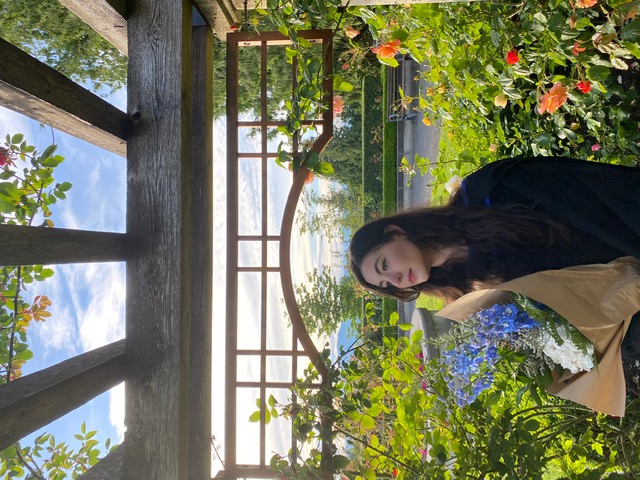
Introduction
About
I completed my MS in Human Language Technology at the University of Arizona in 2025, and my BA in Linguistics at UBC in 2021. My academic and professional backgrounds blend linguistics, computer science, and customer service, providing me with a unique perspective on the intersection of technology and language. I enjoy getting to know people and helping them navigate through technical challenges. My passion is creating and identifying accessible solutions for non-technical audiences and underserved communities. I am excited about working on projects that ensure technology is not only innovative, but approachable. I currently work in customer success at an early-stage AI startup, where I build and deploy production AI agents, own a self-service documentation portal, and run scaled enablement programs that help enterprise customers move from AI curiosity to production adoption. My focus is on making advanced technology approachable and safe — for the teams using it and the customers they serve.
Background
Linguistics
I began my academic journey in 2015 at UBC, initially uncertain about my area of focus. In my first semester, I enrolled in a variety of courses, including a first-year linguistics class titled “Challenging Language Myths.” The course was both enjoyable and engaging, with weekly discussions aimed at debunking common language myths. Topics ranged from traditional linguistic issues (e.g., “Is there such a thing as ‘good’ or ‘bad’ grammar?”) to modern concerns (e.g., “Are emojis and text-speech ruining language?”). Upon completing the course, I decided to pursue a Linguistics major. In my fourth year, I joined a mixed graduate/undergraduate year-long field methods course in which we were paired with an elder from the Secwépemc community. During the course, we researched and documented linguistic patterns in Secwepemctsín, the language of the Secwépemc Nation. I spent the first part of the year working on past and perfect tense markers with a colleague and then spent the second part of the year working on deictic markers and demonstratives. As part of this research, I gave a presentation on my findings to the Salish Working Group at UBC and to a class of Secwépemc learners, researchers, and elders at Simon Fraser University. I spent an additional six months after my degree concluded continuing to do Secwepemctsín language work by annotating and organizing data, and authoring pedagogical resources such as storyboards and grammar exercises under a Jacobs Research Fund group grant.
Computer Science & NLP
In the second year of my Linguistics degree, I attended a department talk on computational linguistics, which introduced me to the field of Natural Language Processing (NLP). The talk covered the current and future directions of NLP and panelists discussed whether computationally-focused courses should be integrated into the linguistics curriculum. I left the talk intrigued by the concept of NLP, but it wasn’t until my fourth year that I began taking computer science courses. Having spent most of my degree in a humanities-focused curriculum, I initially struggled with some of the more math-heavy concepts. However, I enjoyed the problem-solving aspects of coding and the satisfaction of getting my code to compile successfully. Upon the completion of my degree I began working at Global Relay as a Systems Analyst. I created and ran SQL queries, managed and processed datasets, and worked with development, product, and UI teams on testing and suggesting product features. While I enjoyed this role, my curiosity about NLP and desire to deepen my computer science skills led me to apply for UA’s MSc HLT program, which I began in Fall 2023. Through the program, I learned about topics such as speech technology, neural networks, natural language processing, and the algorithms behind them, gaining hands-on experience with tools such as NLTK and PyTorch. As part of my MSc, I completed an internship at an AI solutions company where I built AI agents, explored different agentic workflows, and worked with large language models. I completed the program in May 2025. Since then, I’ve been working in customer success at Kinetic Solutions Group, where I build production AI agents end-to-end, design scaled customer enablement programs, and help enterprise customers adopt AI safely and effectively.